


Table of Contents
- What Non-Toxic Skincare for Sensitive Skin Really Means
- Clean Beauty Ingredients to Avoid When Your Skin Reacts
- How to Patch Test Skincare Products Without Guesswork
- A Non-Toxic Skincare Routine for Beginners, Step by Step
- Ingredient Interactions That Sabotage Sensitive Skin
- Budget Non-Toxic Skincare That Still Works
- Frequently Asked Questions
Last Updated: September 11, 2026
What Non-Toxic Skincare for Sensitive Skin Really Means
Non-toxic skincare for sensitive skin is a product approach that avoids known irritants and questionable synthetic ingredients while supporting the skin's natural barrier. This guide from Djanillie's Beauté breaks down what actually matters when your skin reacts to everything.
The term gets stretched in marketing. Some brands slap "clean" on a label while still loading the formula with fragrance and drying alcohols.
Here's the practical definition: a product is genuinely low-risk for reactive skin when it skips common irritants, keeps the ingredient list short, and supports barrier repair rather than stripping it.
Below, we'll show you exactly which ingredients to avoid, how to patch test without guesswork, and how to build a routine that fits a real budget.
Clean Beauty Ingredients to Avoid When Your Skin Reacts
The fastest way to calm reactive skin is to remove the usual suspects. Most reactions trace back to a short list of ingredients that show up in everything from cleansers to moisturizers.
Fragrance, Essential Oils, and Synthetic Dyes
Fragrance is the leading cause of contact dermatitis in cosmetics, and "natural" fragrance is not automatically safer (the American Academy of Dermatology). Essential oils like lavender, citrus, and peppermint contain the same volatile compounds that trigger reactions. Synthetic dyes such as FD&C colors add no benefit to skin and only increase the risk of irritation.
For reactive skin, fragrance-free and dye-free formulas are the safer default.
Harsh Surfactants, Parabens, and Phthalates
Sulfates like sodium lauryl sulfate strip the lipid barrier and leave skin tight and inflamed. Parabens and phthalates are preservative and texture agents that many health-conscious buyers now avoid, and while the science is still debated, choosing paraben-free and phthalate-free formulas removes the question entirely.
Look for gentle surfactants such as coco-glucoside or sodium cocoyl isethionate instead.
How to Patch Test Skincare Products Without Guesswork
Patch testing removes the guesswork from trying new products, but the version most guides publish, dab it on your forearm, wait a day, you're fine, misses the two reaction types that actually matter for reactive skin.
The Two Reaction Types You Are Testing For
Irritant contact dermatitis is a direct, dose-dependent injury to the skin barrier. It shows up fast (minutes to hours), burns or stings rather than itches, and gets worse the more you apply. Harsh surfactants, high-concentration acids, and denatured alcohol are the usual triggers.
Allergic contact dermatitis is an immune response. It is delayed, typically 24 to 72 hours after first contact, and often presents as itching, small bumps, or a spreading rash that can extend beyond where you applied the product (peer-reviewed research). Fragrance, essential oils, preservatives, and some botanical extracts are the classic culprits. This is the reaction a 24-hour forearm check will miss entirely.
That delay is why the standard one-day test gives false confidence. A product can pass a forearm check and still cause a reaction on day three.
A Patch Test Protocol That Catches Delayed Reactions
- Baseline first. Photograph the test area before you start so you have a clean comparison point.
- Apply to the inner forearm, a small, pea-sized amount on a 1-inch square. Do not rub it in aggressively; apply it the way you would on your face.
- Leave it undisturbed for 48 hours. Do not wash the area with anything but water. Check at 24 hours and again at 48.
- If clear, repeat behind the ear or on the jawline for another 48 hours. These areas have thinner skin and more sebaceous activity, so they react closer to how your face will.
- Only after four reaction-free days should you introduce the product to your full face, and then only one new product at a time.
If you are testing a cleanser, rinse it off after 30 seconds during the patch test rather than leaving it on. Leave-on products (moisturizers, serums, sunscreens) stay on the skin for the full window.
What Counts as a Reaction
Not every response is a fail. Mild transient tingling that fades within a minute is common with some active ingredients and is not the same as a reaction. Stop and discontinue if you see:
- Redness that persists more than an hour after application
- Itching, burning, or stinging that intensifies rather than fades
- Small bumps, flaking, or a rash that spreads beyond the test patch
- Any swelling, blistering, or oozing, discontinue immediately and consult a dermatologist
Keep a Written Log, Not Just a Memory
Track the product name, the date and time of each application, the body site, and what you observed at each checkpoint. Patterns emerge fast. A reaction that seems random often lines up with a product you started five to seven days earlier, and a written log makes that connection obvious in a way memory does not.
A Non-Toxic Skincare Routine for Beginners, Step by Step
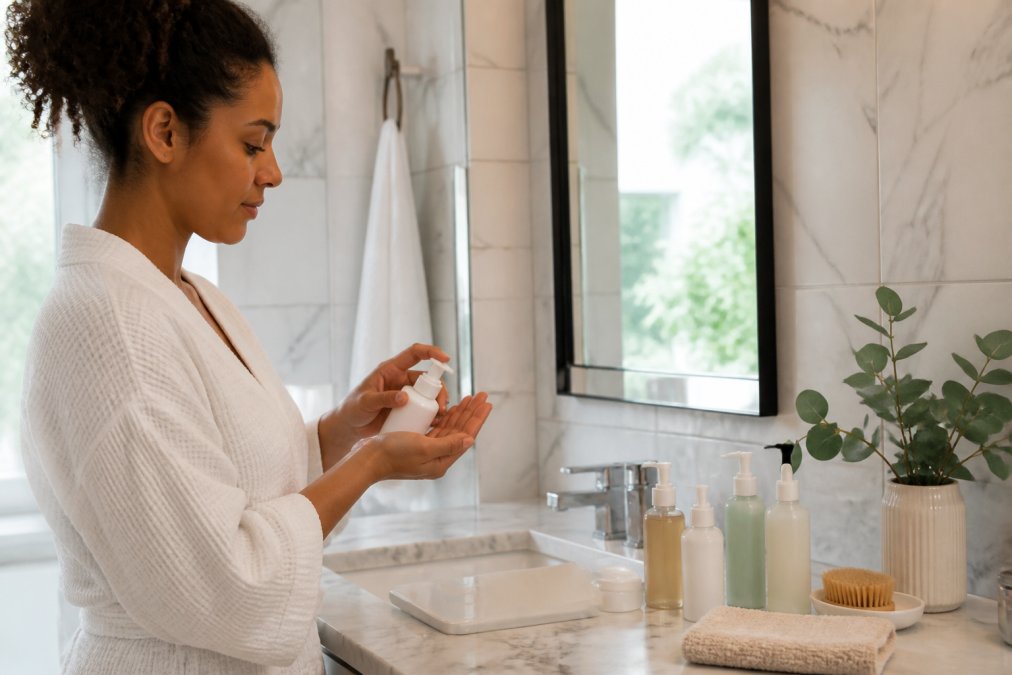
A basic non-toxic routine needs three products, not ten. Cleanser, moisturizer, and sunscreen cover nearly everything sensitive skin requires, but the reason each step matters is mechanical, not marketing.
Why Three Steps Is the Right Number
Sensitive skin usually has a compromised barrier, the outermost layer of skin cells and lipids that keeps water in and irritants out. Every product you add is another set of ingredients your barrier has to tolerate. A short routine reduces the number of variables you are asking your skin to process and makes it possible to identify what actually helps.
Step 1, Cleanse. A pH-balanced, fragrance-free cleanser removes oil, sweat, and environmental debris without stripping the lipid barrier. The target pH for a facial cleanser is roughly 4.5 to 5.5, close to skin's natural acid mantle. Alkaline bar soaps and sulfate-heavy gels push pH higher and leave skin tight and reactive.
Step 2, Moisturize. A moisturizer does two jobs: it adds humectants (glycerin, hyaluronic acid) that pull water into the skin, and it adds occlusives and emollients (ceramides, shea butter, jojoba, squalane) that slow water loss and fill gaps in the barrier. For reactive skin, ceramides are the workhorse, they are the same lipid class the barrier is built from.
Step 3, Protect. Mineral sunscreens built on zinc oxide or titanium dioxide sit on top of the skin and deflect UV rather than absorbing it, which is generally better tolerated by reactive skin than chemical filters. Broad-spectrum SPF 30 or higher, every morning, is the single highest-return step in the routine.
Skip exfoliants, acids, retinoids, and serums for the first month. Add one product at a time so you can isolate what works and what does not.
The Preservative Trade-Off Nobody Mentions
"Preservative-free" sounds safer. For sensitive skin, it often is not.
Any product containing water, cleansers, toners, most moisturizers, needs a preservative system to prevent bacterial and fungal growth. A contaminated product applied to a compromised barrier can cause infections and severe irritation that a well-preserved formula would never trigger. The trade-off is real: some preservatives (notably certain parabens and formaldehyde-releasing agents) are the very ingredients sensitive-skin buyers want to avoid, while others (phenoxyethanol, sodium benzoate, potassium sorbate) are widely used and generally well tolerated at cosmetic concentrations.
The practical takeaway: anhydrous products, balms, oils, and ointments with no water content, can legitimately be preservative-free. Water-based products that claim to be preservative-free deserve a closer look at the label, because something is keeping that formula stable.
Three Products That Cover the Basics
Djanillie's Beauté builds its skincare line around exactly this principle: fewer products, better formulas. The Pure Radiance Anti-Aging Cleanser ($39.99) handles the cleansing step without stripping. The Phyto-Essential Hydrating Toner ($45.99) rebalances skin after washing. And the Nutri-Lux Total Therapy Creme ($62.99) seals in moisture with botanical extracts. For body care, the Luxe Body Soufflé ($29.99) applies the same approach to dry, reactive skin below the neck.


That's a complete routine, and every formula is non-toxic by design.
How to Read a Label Before You Buy
Ingredient lists are ordered by concentration, highest to lowest, down to 1%. Anything after the first few entries is present in small amounts. That matters when a brand touts a botanical extract that appears near the bottom of a 40-ingredient list, the marketing claim and the actual concentration are two different things.
Look for: short lists, fragrance-free and dye-free declarations, ceramides or plant oils near the top of the moisturizer list, and a preservative system you recognize.
Be cautious of: "fragrance" or "parfum" anywhere on the list, essential oils marketed as the active ingredient, denatured alcohol in the first five ingredients of a leave-on product, and "preservative-free" claims on water-based formulas.
Ingredient Interactions That Sabotage Sensitive Skin
Two safe ingredients can still cause a reaction when layered together. This is the part most guides miss.
Retinol plus vitamin C, for example, is a common pairing that overwhelms reactive skin. Acids plus niacinamide can trigger flushing in some people. Even antioxidant-rich formulas layered with exfoliants can push the barrier past its limit.
The fix is spacing. Use one active ingredient per routine, and give your skin a rest day between treatments. If you're introducing something new, do it alone for two weeks before adding anything else.
Budget Non-Toxic Skincare That Still Works
You do not need to spend a fortune to avoid irritants. Many affordable drugstore formulas are already fragrance-free, dye-free, and paraben-free; you just have to read the label.
A simple budget approach:
- Choose one gentle cleanser under $15
- Use plain colloidal oatmeal or petroleum jelly as an occlusive at night
- Buy sunscreen in larger sizes to lower the cost per ounce
- Skip toners, essences, and multi-step routines until your skin stabilizes
The trade-off is fewer "active" ingredients. That's fine. For reactive skin, gentle and consistent beats potent and complicated almost every time.
| Step | Product Type | Key Ingredient to Look For | What to Avoid |
|---|---|---|---|
| Cleanse | Fragrance-free gel or cream | Coco-glucoside | Sulfates, fragrance |
| Tone | Alcohol-free hydrating mist | Glycerin, aloe | Denatured alcohol |
| Moisturize | Ceramide or botanical cream | Shea, jojoba, ceramides | Parabens, dyes |
| Protect | Mineral sunscreen | Zinc oxide, titanium dioxide | Chemical filters, fragrance |
Frequently Asked Questions
What ingredients should I avoid in non-toxic skincare for sensitive skin?
Start by skipping synthetic fragrance, essential oils like citrus and lavender, synthetic dyes, parabens, phthalates, and harsh sulfates such as SLS. These are the most common triggers for redness, stinging, and contact dermatitis. Look for labels that say fragrance-free rather than unscented, since unscented products can still contain masking fragrances. A short ingredient list built around hypoallergenic, plant-derived ingredients is easier to scan than a long one full of unpronounceable additives.
How do I patch test skincare products before using them on my face?
Apply a small amount behind your ear or on your inner forearm, then wait 24 to 48 hours. If no redness, itching, or bumps appear, repeat on a small patch of jawline skin for another 24 hours before going full-face. Introduce one new product at a time so you can identify the culprit if a reaction happens. Keep a simple note of the date and product name. This process matters most with botanical extracts and essential oils, which trigger reactions more often than plain hydrating ingredients.
Is organic skincare always better for sensitive skin?
No. Certified organic refers to how ingredients were farmed, not how gentle they are on reactive skin. Some organic essential oils and botanical extracts cause irritation, while some lab-made ingredients like niacinamide or hyaluronic acid are well tolerated. What matters more is whether a formula is fragrance-free, pH-balanced, dermatologist-tested, and free of known irritants. Read the full ingredient list rather than trusting the organic seal alone.
Can I build a non-toxic skincare routine on a budget?
Yes. A basic routine needs only three steps: a gentle pH-balanced cleanser, a hydrating toner or serum, and a moisturizer that supports skin barrier repair. Drugstore and mid-range brands now make fragrance-free, paraben-free options that cost less than $20 per product. Buy full sizes only after patch testing travel or sample sizes. Spending more does not guarantee fewer reactions; a short, consistent routine with products you tolerate beats a shelf full of expensive items you cannot use.
Sensitive skin doesn't have to mean settling for products that irritate or underperform. Djanillie's Beauté formulates every product around non-toxic ingredients that nurture and rebalance reactive skin, from the Pure Radiance Anti-Aging Cleanser to the Nutri-Lux Total Therapy Creme, and donates 30% of profits to support urban farming in Haiti. If you're ready to build a routine that respects your skin and your values, get started with Djanillie's Beauté and add to cart today.