
Choosing a hair product should feel empowering, not confusing. Yet words like clean, natural, botanical, and non-toxic can make every shopping trip feel like an ingredient-science exam.
For women with curly, coily, kinky, and wavy hair, label literacy is especially valuable. Diverse textures often need thoughtful cleansing, rich hydration, gentle detangling, and consistent protection from dryness and breakage. The right formula can help you nurture, detoxify, hydrate, and protect your strands while supporting your long-term length-retention goals.
The good news? You do not need to memorize every ingredient in the beauty aisle. You simply need a practical way to look beyond the front label, understand what the formula is designed to do, and choose products that align with your hair, scalp, and values.
Clean Beauty Starts With Clarity
The word “clean” does not have one universal legal definition for cosmetics in the United States. Brands, retailers, and certification programs may use different standards. That means a product can look beautifully “clean” on the shelf while still leaving important questions unanswered.
This does not mean every clean-beauty product is misleading. It means you should treat the claim as an invitation to investigate, not as a guarantee.
Start by asking:
- Does the brand publish a complete ingredient list?
- Does it explain what “clean” means within its own formulation standards?
- Are claims such as cruelty-free, botanical, organic, or vegan supported with details?
- Does the product address your actual hair needs?
- Is the formula transparent about fragrance, preservatives, and potential sensitivities?
A trustworthy brand should help you make an informed decision without fearmongering. An unfamiliar ingredient is not automatically harmful, and a plant-derived ingredient is not automatically right for every person. Formula performance, concentration, personal sensitivity, and proper use all matter.
Research on products marketed to people with textured hair also shows why label awareness is important. A peer-reviewed review of clean beauty products and textured hair emphasizes that marketing language and ingredient transparency do not always tell the same story.

Read the First Five To Ten Ingredients First
Ingredients are generally listed from the highest concentration to the lowest, with some flexibility for ingredients used at very low levels. This makes the first five to ten ingredients a helpful starting point.
Think of them as the formula’s foundation.
For textured hair, you may commonly see:
- Water or Aqua: The base of many shampoos, conditioners, sprays, and leave-in products.
- Conditioning agents: These help provide slip, softness, and manageability.
- Fatty alcohols: Ingredients such as cetearyl alcohol are not the same as drying alcohols. They can help create a creamy, conditioning texture.
- Humectants: Glycerin, aloe, and panthenol help attract and hold moisture.
- Oils and butters: Shea butter, sunflower oil, coconut oil, jojoba oil, and other emollients may help soften the hair and support moisture retention.
- Proteins and amino acids: These can help improve the feel and strength of hair that is fragile or prone to breakage.
The ingredient order does not tell you everything, but it gives you a practical preview. If a product is marketed as deeply nourishing, yet its opening ingredients are mostly strong cleansers, volatile alcohols, or lightweight styling agents, it may be designed more for cleansing, hold, or quick styling than deep moisture.
Neither is automatically wrong. The important question is whether the product’s purpose matches your needs.
Learn The Difference Between “Natural,” “Botanical,” And “Plant-Based”
These terms are often used together, but they do not mean exactly the same thing.
Natural usually suggests that a product contains ingredients from natural sources. It does not necessarily mean that every ingredient is natural, organic, or minimally processed.
Botanical generally points to plant ingredients such as roots, flowers, leaves, seeds, fruits, or herbs. Look for recognizable plant names or INCI names, which may use the botanical or Latin name of the plant.
Plant-based often means that some or many ingredients come from plants. It does not always mean the entire formula is made exclusively from plants.
A botanical ingredient appearing near the very end of a long list may be present in a small amount. That does not make it meaningless, but it does mean you should avoid assuming that one highlighted plant on the front label defines the entire formula.
At Djanillie’s Beauté, botanical and organic clean ingredients are foundational to our approach. Our goal is to pair nurturing plant ingredients with advanced, non-toxic formulations that perform beautifully across every texture, not simply to decorate a label with a fashionable claim.
Understand What Common Claims Really Promise
“Clean”
There is no single universal definition. Look for the brand’s published standards and complete ingredient list.
“Cruelty-Free”
This refers to animal testing. It does not automatically mean a product is vegan, botanical, or free from synthetic ingredients. If those values matter to you, look for each claim separately.
“Vegan”
This generally means the formula does not contain animal-derived ingredients. It does not automatically mean the product is gentle, organic, or suitable for sensitive scalps.
“Organic”
Organic claims can refer to specific ingredients or the entire product. Certifications and details matter. A product containing one organic botanical is not necessarily an entirely organic formula.
“Non-Toxic”
This claim should be connected to a clear formulation philosophy. Ask what the brand excludes, how it evaluates ingredients, and whether it provides a full INCI list. “Non-toxic” should lead to more transparency, not less.
“Chemical-Free”
This is a marketing phrase to approach carefully. Everything, including water and botanical extracts, is made of chemicals in the scientific sense. A better question is: Which ingredients are included, why are they included, and how does the finished formula support my hair and scalp?
Look For What Your Texture Actually Needs
Textured hair is not one category. Fine waves, dense coils, high-porosity curls, color-treated hair, and chemically treated hair can all respond differently to the same formula.
Before buying, clarify your immediate goal:
- Do you need gentle cleansing?
- More slip for detangling?
- Lightweight hydration?
- Rich moisture for dry ends?
- Strength and repair?
- Heat protection?
- Scalp comfort?
- Better hold without excessive stiffness?
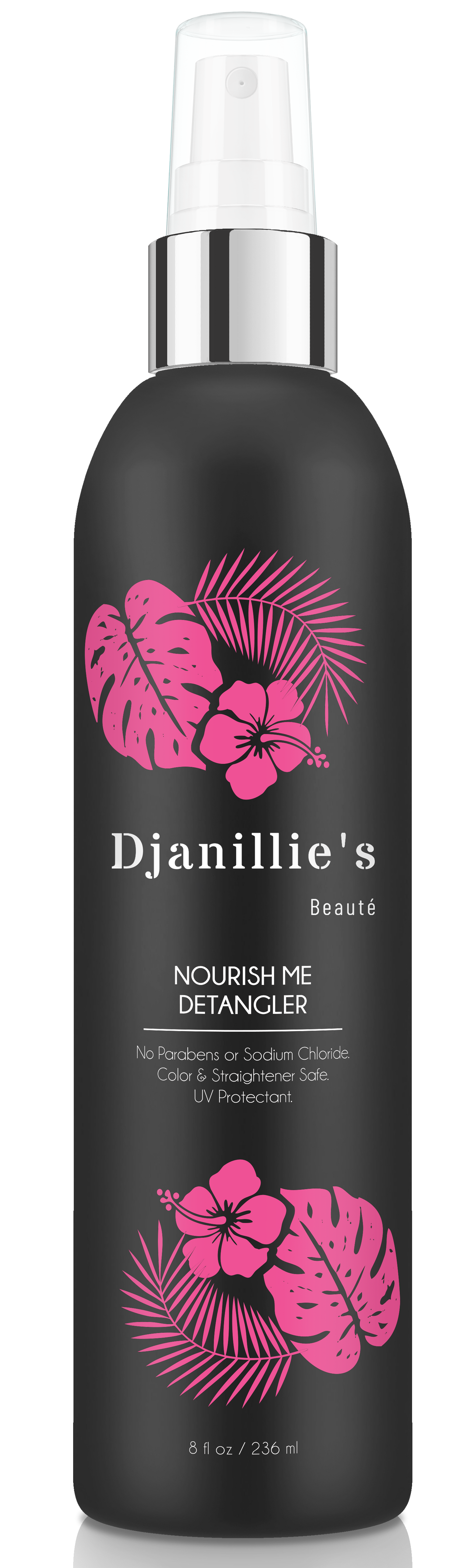
For example, Djanillie’s Beauté Nourish Me Detangler lists panthenol, wheat amino acids, glycerin, aloe, and multiple botanical extracts. The product page describes it as a detangling conditioner that helps add shine, body, conditioning, and manageability.
The same page also presents the complete ingredient list, including fragrance and preservatives. That level of visibility allows you to make a personal choice. If you have known sensitivities, you can review those ingredients with a dermatologist or qualified healthcare professional before use.
Be Thoughtful About Fragrance And Preservatives
“Clean” does not mean “preservative-free.” Water-based products need preservation to help prevent microbial growth and maintain product safety. Preservatives and stabilizers can be important parts of a well-designed formula.
Fragrance, however, is worth noticing, especially if your scalp or skin is sensitive. On a label, it may appear as fragrance or parfum. Consider how high it appears on the ingredient list and whether the brand explains its fragrance approach.
You may also choose to be mindful of ingredients such as:
- Sulfates, especially if your hair becomes dry after cleansing
- Short-chain or denatured alcohols, which may feel drying for some textures
- Parabens, phthalates, or formaldehyde-releasing preservatives if they are part of your personal avoid list
- Essential oils, if your scalp is reactive or allergy-prone
This is not a call to panic over one word. It is a reminder to create a personal “yes list” and “no list” based on your experience, preferences, and professional guidance: not internet fear.
Connect Label Literacy To Length Retention
Healthy hair growth begins at the scalp, but visible length depends heavily on what happens along the strand. Curly and coily hair can be more vulnerable to dryness, tangling, friction, and mechanical breakage. A product cannot promise to change your natural growth rate, but a supportive routine may help you retain more of the length you grow.
Look for formulas and habits that help you:
- Cleanse without leaving your hair feeling stripped.
- Condition consistently.
- Detangle with plenty of slip.
- Reduce pulling and friction.
- Protect your ends.
- Use heat protectant when styling with heat.
- Avoid layering products that create unnecessary buildup.
- Give your hair time to respond before constantly changing your routine.
Djanillie’s Beauté offers collections designed for diverse textures, including the Botanical Hydration Shampoo and Conditioner, Magic Growth Hair Serum with Chebe, and Caviar Bond Repair System. Each product should be evaluated according to its ingredient list, intended use, and your own hair’s response.
Choose Beauty With A Purpose
Label literacy is not only about avoiding unwanted ingredients. It is also about choosing brands whose values reflect your own.
Djanillie’s Beauté is based in Houston, Texas, and creates high-performance skincare and haircare for all skin types and every texture. Our approach is botanical, ecological, cruelty-free, and centered on clean, non-toxic formulations that nurture both beauty and well-being.
Our mission extends beyond the mirror. Thirty percent of profits support urban farming in Haiti, helping strengthen local farming communities, support rural economies, and encourage greater sustainability.
That means your beauty ritual can become part of something larger: a vibrant, purpose-driven journey that supports healthy hair, conscious choices, and global community care.
Your Simple Label-Reading Checklist
Before adding a product to your cart, pause and ask:
- What is this product meant to do?
- Do the first five to ten ingredients support that purpose?
- Are there humectants, conditioners, oils, butters, proteins, or botanicals my hair responds well to?
- Are fragrance and preservatives clearly listed?
- Does “clean” have a clear meaning on this brand’s website?
- Does the product suit my hair’s porosity, density, texture, and styling routine?
- Does the brand’s mission align with my values?
You do not need a perfect product or a perfect routine. You need a transparent formula, realistic expectations, and a nurturing approach that helps your hair thrive over time.
Feel free to contact us with questions about choosing products for your routine. Stay connected, keep learning, and join us on a journey toward radiant, healthy hair: with beauty that gives back.
Djanillie’s Beauté