


Table of Contents
- Why 4C Hair Loses Moisture So Fast
- Signs of Product Buildup on Natural Hair
- LCO vs LOC Method for 4C Hair: Which Order Works Best?
- How to Moisturize 4C Hair Step by Step
- How to Clarify 4C Hair Without Stripping It
- Choosing Oils and Products That Won't Cause Buildup
- How Often to Moisturize 4C Hair Without Overdoing It
- Frequently Asked Questions
Last Updated: September 12, 2026
Why 4C Hair Loses Moisture So Fast
Moisture retention in 4C hair is a structural challenge, not a product failure. The tightest curl pattern in the type 4 family has fewer cuticle layers and an irregular hair shaft, so water escapes almost as quickly as it enters. This guide from Djanillie's Beauté breaks down how to moisturize 4C hair without the greasy buildup that sabotages most routines.
The tension most guides ignore: the oils people use to "lock in" moisture are often the same ones creating the coating that blocks it. Understanding your porosity changes which products work.
Low Porosity vs High Porosity: Which One Are You?
Low porosity 4C hair has tightly closed cuticles: water sits on top rather than absorbing, and products accumulate on the surface. High porosity hair has gaps and lifted cuticles, so moisture rushes in but escapes just as fast.
A simple test: drop a clean strand into a glass of water. If it floats for several minutes, you're likely low porosity. If it sinks quickly, you're likely high porosity.
The distinction dictates your layering order. Low porosity hair needs lightweight, water-soluble products and gentle heat to lift the cuticle; high porosity hair needs heavier sealants to slow moisture loss. Getting this wrong is the most common reason a routine produces buildup instead of softness.
Signs of Product Buildup on Natural Hair
Buildup announces itself before it causes visible damage. Watch for these signals:
- Hair feels coated or waxy even after washing
- Coils look dull despite regular moisturizing
- Strands feel stiff rather than soft
- Scalp itches or flakes between wash days
- Moisture seems to "sit" on top instead of absorbing
- Hair sheds more during detangling
Buildup and dryness feel similar at first, but buildup has a slick or tacky texture, while genuinely dry hair feels brittle and rough.
LCO vs LOC Method for 4C Hair: Which Order Works Best?
The LCO method works better for most 4C hair types. LCO stands for Liquid, Cream, Oil: apply water-based leave-in first, then a cream, then seal with oil. LOC reverses the last two steps, applying oil before cream.
| Method | Order | Best For | Watch Out For |
|---|---|---|---|
| LCO | Liquid, Cream, Oil | Low porosity, fine strands | Heavy creams can sit on top |
| LOC | Liquid, Oil, Cream | High porosity, thick strands | Oil barrier blocks cream absorption |
For low porosity 4C hair, LCO keeps cream in contact with the strand where it can penetrate. For high porosity hair, LOC's oil layer fills cuticle gaps before cream seals everything in.
Neither method works if you skip the liquid step. Water is the actual moisturizer. Everything else just holds it there.
How to Moisturize 4C Hair Step by Step
A buildup-free routine takes about 20 minutes on wash day and 5 minutes on refresh days. Follow this sequence for consistently soft coils without residue.
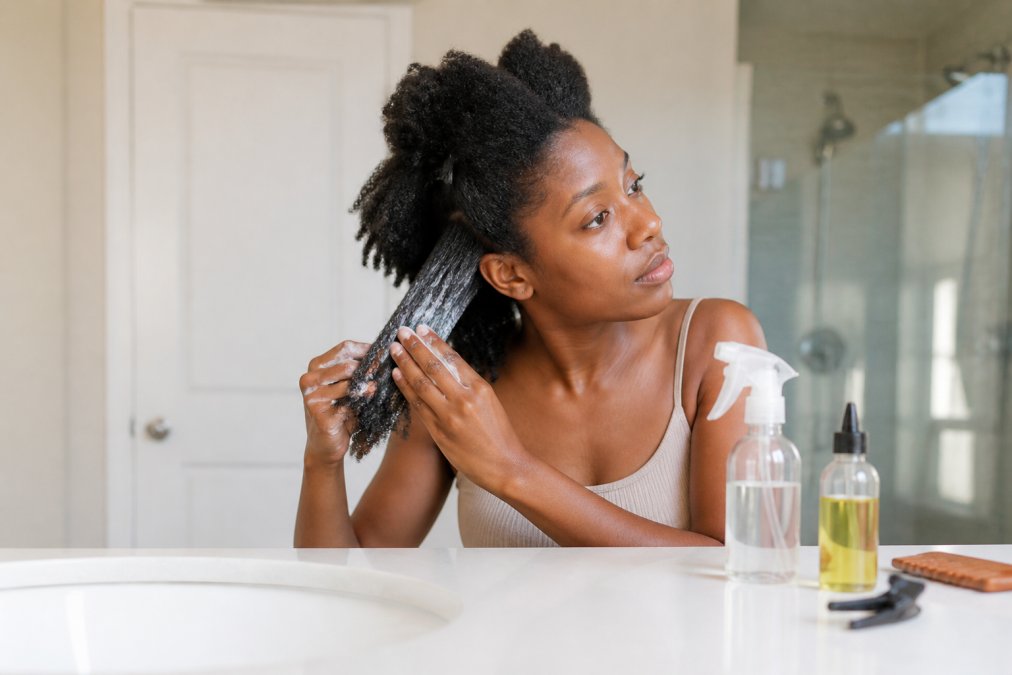
Step 1: Start With Clean, Clarified Hair
Moisturizing over buildup wastes product and traps debris. Wash with a clarifying shampoo at least once a month, or more often if you use heavy butters and gels. A dermatologist-reviewed guide to scalp and hair cleansing notes that scalp health directly affects how well hair retains moisture, so don't skip the scalp.
Step 2: Layer Water, Leave-In, Then Oil
Work in sections. Spritz each section with water until damp, apply a water-based leave-in, then seal with a lightweight oil. Djanillie's Beauté's Leave-In Therapy is formulated for exactly this step, and the Moroccan Argan Oil Serum seals without the heavy coating that cheaper oils leave behind.


Step 3: Seal and Protect Overnight
Twist or braid each section loosely, then cover with a satin bonnet or sleep on a silk pillowcase. Cotton wicks moisture from hair overnight through friction, undoing your work.
How to Clarify 4C Hair Without Stripping It
Clarifying removes buildup; stripping removes everything, including the natural oils your scalp needs. The difference comes down to the surfactant system, contact time, and how quickly you replace what was removed.
What Actually Removes Buildup
Buildup on 4C hair is usually a stack of non-water-soluble silicones, heavy butters and waxes, and polymer film-formers from gels. Water alone cannot lift them; you need a surfactant that solubilizes oil-based residue.
The strongest option is a shampoo built on anionic surfactants, look for sodium lauryl sulfate (SLS) or sodium laureth sulfate (SLES) near the top of the ingredient list. These carry a negative charge that binds to oil and lifts it off the cuticle. They are the most effective at removing silicone, which is why most sulfate-free routines eventually hit a wall.
The gentler option is a chelating or clarifying shampoo built on milder surfactants like cocamidopropyl betaine, often paired with EDTA or phytic acid. These target hard-water minerals, calcium and magnesium ions that bond to the shaft and make it feel rough even when technically clean. If your water leaves spots on glass, this is likely part of your buildup problem.
A co-wash with a light surfactant is fine for maintenance between clarifying sessions but will not remove silicone or heavy butter residue on its own.
A Concrete Clarifying Schedule
Most practitioners find this cadence works for 4C hair:
- Every 2 weeks: If you use heavy gels, butters, edge control, or products containing dimethicone or other non-water-soluble silicones.
- Every 3 to 4 weeks: If your routine is lightweight, water-based leave-in, a penetrating oil, and no styling products with film-formers.
- As needed: After any single use of a heavy wax, pomade, or silicone-heavy serum. Do not wait for the scheduled reset.
A useful test between sessions: mist a section with plain water. If it beads and rolls off, you have a coating to remove; if it absorbs and the hair feels damp, your schedule is working.
How to Clarify Without Wrecking Your Hair
- Pre-detangle and section. Clarifying shampoo makes hair temporarily rougher, so detangle fully before wetting.
- Focus on the scalp and roots first. That is where sebum, dead skin, and product concentrate. Work the lather in with fingertips, not nails.
- Limit contact time. One to two minutes of lathering is enough; five minutes causes the squeaky, stripped feeling.
- Rinse with cool or lukewarm water. Hot water lifts the cuticle further and accelerates moisture loss.
- Deep condition immediately. Clarifying lifts the cuticle, exactly when hair absorbs conditioning ingredients best. Apply a moisturizing deep conditioner with heat for 15 to 30 minutes; skipping this leaves hair brittle and prone to breakage.
- Seal while damp. Follow with your normal liquid-cream-oil layering before the hair fully dries.
When to Skip Clarifying
Do not clarify if your scalp is irritated, if you colored or chemically treated your hair within the past week, or if you clarified within the last several days. Over-clarifying strips the scalp's lipid barrier, triggering rebound oil production and flaking.
A gentle option for maintenance between resets: Djanillie's Beauté's Detox Exfoliating Shampoo clears residue while supporting scalp balance. For a gentler weekly cleanse, a co-wash works between clarifying sessions.
Choosing Oils and Products That Won't Cause Buildup
Buildup is a chemistry problem, not a product-quality problem. The variable that predicts whether an ingredient accumulates on 4C hair is whether it dissolves in water. Most guides list "light" and "heavy" oils without explaining why some rinse clean and others do not, that distinction is the root cause of the coating most people fight.
Water-Soluble vs. Non-Water-Soluble: The Real Divide
Every ingredient in your routine falls into one of two categories:
Water-soluble ingredients dissolve or disperse in water and rinse out with a normal wash, so they cannot accumulate across wash days. Examples: glycerin, panthenol (provitamin B5), aloe vera juice, hydrolyzed proteins, and most water-based leave-ins.
Non-water-soluble ingredients repel water, sit on the hair shaft, and only come off with a surfactant strong enough to break the oil-water barrier, hence the need for a sulfate or clarifying shampoo. Examples: dimethicone, cyclomethicone, amodimethicone, mineral oil, petrolatum, beeswax, and most heavy butters and oils.
This is the buildup cycle: you layer a non-water-soluble oil or silicone, it coats the strand, you add more moisturizer because hair still feels dry, and the coating thickens. Water-based products underneath cannot reach the cortex through the film.
Reading the Ingredient Label for Buildup Risk
Silicones are the most common hidden culprit. Watch for these suffixes:
- -cone (dimethicone, amodimethicone), non-water-soluble, requires sulfate to remove
- -siloxane (cyclomethicone, cyclopentasiloxane), volatile, evaporates but can leave residue when layered
- -conol (dimethiconol), non-water-soluble, heavy coating
- PEG- or PPG- prefixed silicones (PEG-dimethicone), water-soluble, generally rinse clean
The PEG and PPG prefixes indicate the silicone has been modified to dissolve in water. These are the ones that will not build up. If a label lists dimethicone without a PEG or PPG prefix and you are avoiding sulfates, that product will accumulate.
Oils Ranked by Buildup Potential
Penetrating oils (low buildup risk): These have small molecules that partially enter the cortex rather than sitting on the surface. Grapeseed, jojoba, and argan are the most cited. Jojoba is a liquid wax ester that mimics human sebum, so it absorbs without a greasy film.
Sealing oils (moderate buildup risk): Coconut and olive oil penetrate partially but leave more surface residue. They suit high porosity hair that needs a heavier sealant, but on low porosity 4C hair they contribute to coating.
Coating oils (high buildup risk): Castor oil, mineral oil, and petrolatum sit almost entirely on the surface. They seal very high porosity hair or protect ends in long-term protective styles, but require a strong clarifying shampoo and should not be part of a frequent moisturizing routine.
The Layering Rule That Prevents Buildup
Order products from most to least water-soluble: water first, then a water-based leave-in, then a penetrating oil, then, only if needed, a heavier sealant on the ends. Reverse this and a non-water-soluble oil goes down first, so everything after sits on the film instead of reaching the hair.
A practical check: after your routine dries, mist a small section with water. If the water beads, you have a non-water-soluble layer on top and you have over-sealed. If it absorbs, your layering is correct.
How Often to Moisturize 4C Hair Without Overdoing It
Most 4C hair needs moisturizing two to three times per week, not daily. (the American Academy of Dermatology) Over-moisturizing causes hygral fatigue, where the cuticle swells and contracts repeatedly until it weakens.
Between sessions, refresh with a water-based spritz rather than a full reapplication. Water plus a few drops of leave-in in a spray bottle reactivates yesterday's products without adding a new layer.
If you wear protective styles like twists or braids, you can stretch to once or twice a week by focusing moisture on the scalp and the exposed ends rather than the whole length.
Moisturizing 4C hair without buildup comes down to one principle: water hydrates, everything else just holds it in place. When your products layer correctly and you clarify on schedule, coils stay soft without the waxy residue that makes you want to wash everything out.
Djanillie's Beauté formulates for exactly this balance. The Leave-In Therapy, Moroccan Argan Oil Serum, and Curly Kids Moisturizing Hair Oil deliver high-performance hydration with non-toxic ingredients, and 30% of profits support urban farming programs in Haiti. Get started with Djanillie's Beauté and build a moisture routine your coils can actually absorb.

Frequently Asked Questions
How do I keep my 4C hair moisturized all day?
Start with damp hair, not soaking wet. Apply a water-based leave-in conditioner in small sections, then seal with a lightweight oil like grapeseed or jojoba. At night, cover your hair with a satin bonnet or sleep on a silk pillowcase to reduce friction and moisture loss. If your coils feel dry by midday, mist with water and smooth a few drops of oil over the ends rather than re-applying heavy cream.
How often should you moisturize 4C hair to avoid buildup?
Most 4C hair does well with moisturizing every two to three days, or whenever the hair feels dry rather than on a fixed schedule. Reapplying heavy butters daily is what causes product buildup, not the frequency itself. If you use a water-based spritz and a light oil, you can refresh more often. Deep condition once a week and clarify every four to six weeks to keep the hair shaft clear.
Does water count as a moisturizer for 4C hair?
Water is the only true moisturizer for hair. Everything else, including leave-in conditioners and oils, works by helping water stay inside the hair shaft or by slowing moisture loss. That is why the LOC and LCO methods both start with water. Applying oil to dry hair without water first just coats the strands and can trap buildup underneath, leaving coils feeling greasy but still dry.
What are the signs of product buildup on natural hair?
Watch for dull, coated strands, hair that feels stiff or waxy, flakes near the scalp, and coils that won't absorb water or conditioner no matter how much you apply. Buildup also shows up as increased breakage and shedding because the hair shaft can't flex properly. If your usual products stop working, that's often the first clue. A gentle clarifying wash every four to six weeks usually resolves it.